
αφήστε ένα μήνυμα
Αν ενδιαφέρεστε για τα προϊόντα μας και θέλετε να μάθετε περισσότερες λεπτομέρειες, αφήστε ένα μήνυμα εδώ, θα σας απαντήσουμε το συντομότερο δυνατό.




Η καλύτερη αγορά που έκανα αυτόν τον χειμώνα! Το χρώμα και το πλέξιμο είναι εξαιρετικά και είναι τόσο άνετο! Πήγα από τη Νέα Υόρκη στο Μαϊάμι χωρίς να το βγάλω ποτέ. Υπερβολικά χαριτωμένο!!
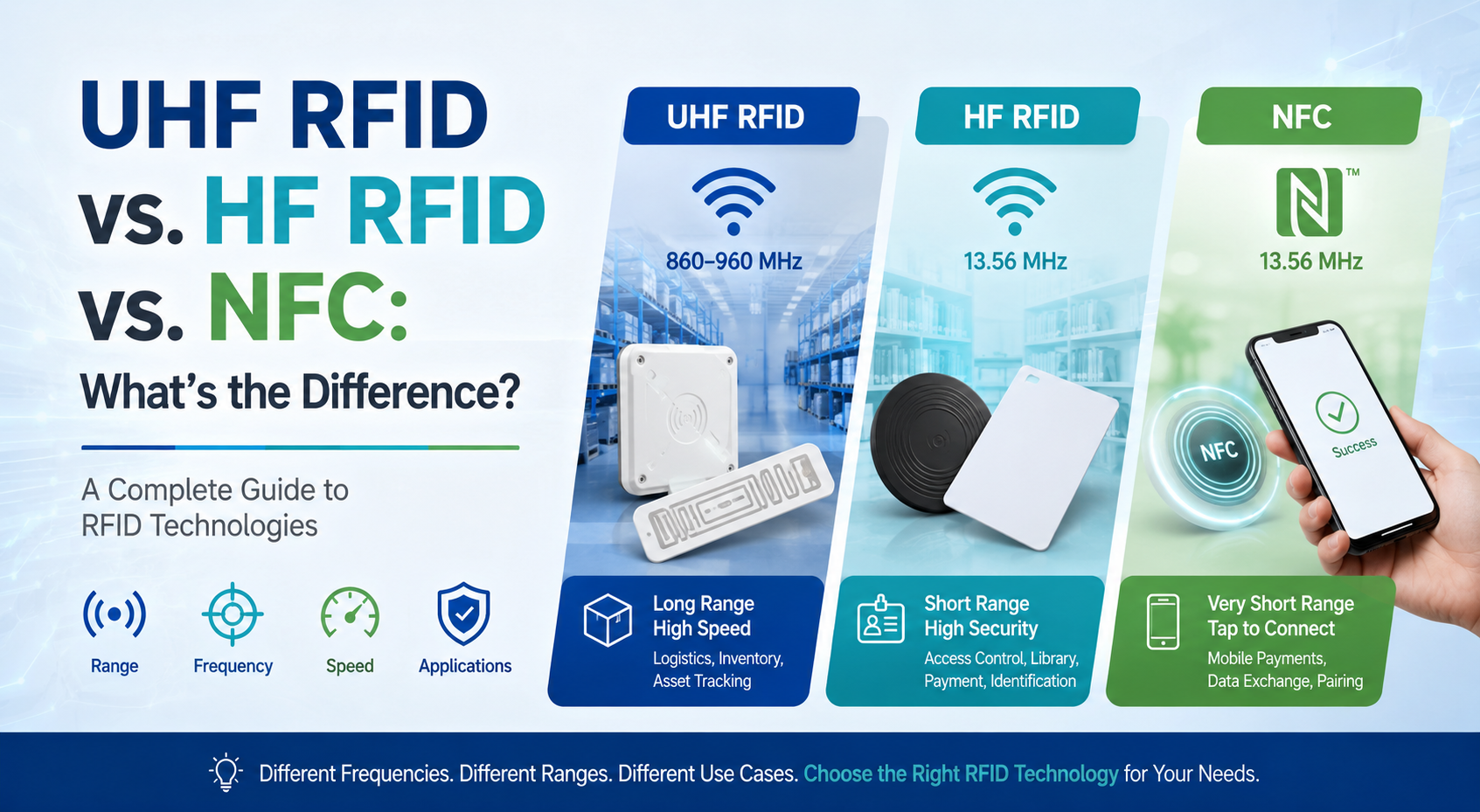
RFID and NFC technologies are becoming increasingly important in retail, logistics, manufacturing, healthcare, access control, asset tracking, and smart consumer products. Among the most commonly discussed technologies are UHF RFID, HF RFID, and NFC. Although they all use radio-frequency communication, they are designed for different purposes and offer different levels of reading distance, speed, connectivity, and user interaction.
Understanding the difference between UHF RFID, HF RFID, and NFC is essential when selecting the right identification or wireless communication technology for a project. Choosing the wrong technology can lead to poor reading performance, unnecessary hardware costs, or an unsatisfactory user experience.
This article explains the key differences between UHF RFID, HF RFID, and NFC, including their operating frequencies, communication ranges, advantages, limitations, applications, and typical use cases.
RFID stands for Radio Frequency Identification. It is a wireless technology that uses radio waves to identify and exchange information with electronic tags. A typical RFID system consists of an RFID tag, an RFID reader, antennas, and software that processes the collected data.
An RFID tag generally contains an integrated circuit and an antenna. Depending on the type of RFID system, the tag can store identification numbers, product information, asset data, or other digital information.
RFID technology is commonly divided into three major frequency categories: Low Frequency (LF), High Frequency (HF), and Ultra-High Frequency (UHF). HF RFID and NFC both operate at 13.56 MHz, but NFC is specifically designed for very short-range communication and consumer-device interaction.
UHF RFID stands for Ultra-High Frequency Radio Frequency Identification. UHF RFID systems typically operate within the 860–960 MHz range, depending on regional regulations.
One of the biggest advantages of UHF RFID is its relatively long reading distance. Compared with HF RFID and NFC, UHF RFID can generally communicate with tags from a much greater distance. Under suitable conditions, some systems can read tags several meters away.
UHF RFID also supports fast and efficient multi-tag reading. This makes it particularly valuable in warehouses, distribution centers, retail stores, manufacturing facilities, and supply chain applications.
For example, a warehouse employee can use a handheld UHF RFID reader to scan multiple tagged products without physically locating each individual item. Fixed UHF RFID readers can also automatically identify tagged products as they pass through a warehouse entrance.
UHF RFID is widely used for applications that require long-range identification and high-volume tag reading.
Common applications include:
The key value of UHF RFID is automation. Instead of requiring employees to scan individual barcodes one by one, RFID systems can automatically identify multiple objects within the reader's coverage area.
HF RFID stands for High Frequency Radio Frequency Identification and operates at 13.56 MHz.
HF RFID is designed primarily for short-range communication. Its typical reading distance is shorter than UHF RFID, but it can provide reliable performance in many applications where close-range identification is required.
HF RFID has been widely adopted for access cards, smart cards, library systems, ticketing, industrial identification, and other applications.
One important characteristic of HF RFID is that its performance can be relatively suitable for applications involving people or objects containing liquids. However, actual performance always depends on tag design, antenna configuration, materials, and the surrounding environment.
Typical HF RFID applications include:
HF RFID is often a good choice when the user or system is expected to bring the tag relatively close to the reader.
NFC stands for Near Field Communication. It operates at 13.56 MHz and is closely related to HF RFID technology.
However, NFC is more specifically designed for short-range communication between compatible devices, such as smartphones, NFC tags, payment terminals, smart cards, and other electronic devices.
The biggest advantage of NFC is convenience. Modern smartphones can support NFC, allowing users to simply tap their phone against an NFC tag or NFC-enabled device.
NFC can be used to open a website, share information, authenticate a product, connect devices, launch an application, or make contactless payments.
NFC is widely used in consumer-facing applications, including:
For example, a company can place an NFC tag on product packaging. When a customer taps the tag with a smartphone, the phone can open a product webpage, display product information, provide authentication services, or offer a digital marketing experience.
The main differences between UHF RFID, HF RFID, and NFC can be summarized as follows:
Actual performance varies depending on the reader, antenna, tag design, power level, materials, installation environment, and applicable regulations.
The biggest difference between UHF RFID and HF RFID is the balance between reading distance and application environment.
UHF RFID is generally better when a business needs long-range reading and the ability to identify many tags quickly. For example, a logistics company may use UHF RFID to track pallets moving through a warehouse.
HF RFID is usually more appropriate for close-range identification. A user may need to place a card or tag close to the reader before communication takes place.
Therefore, UHF RFID is often preferred for automated supply chain applications, while HF RFID is commonly used for cards, tickets, libraries, and controlled short-range identification.
UHF RFID and NFC serve very different purposes despite both using radio-frequency communication.
UHF RFID is primarily designed for machine-to-object identification. It can read multiple tags over a relatively long distance and is therefore useful for inventory management and logistics.
NFC, on the other hand, is primarily designed for close-range interaction between a user and an electronic device. A smartphone user can intentionally tap an NFC tag to trigger an action.
In simple terms, UHF RFID is optimized for “automatic identification,” while NFC is optimized for “intentional interaction.”
HF RFID and NFC are closely related because both operate at 13.56 MHz. However, they are not exactly the same thing.
HF RFID is a broader technology category used in many identification and industrial applications. NFC is a specific short-range communication technology designed for interoperability between NFC-enabled devices and tags.
NFC also benefits from broad smartphone support. This makes it particularly attractive for consumer applications where the user needs to interact directly with a physical product.
For example, an HF RFID system might be used for library management, while an NFC tag might be used on a product package to provide customers with digital product information.
There is no universal answer to which technology is best. The right choice depends on the application's requirements.
Choose UHF RFID when you need:
Choose HF RFID when you need:
Choose NFC when you need:
Before selecting UHF RFID, HF RFID, or NFC, businesses should consider more than just operating frequency.
If the system needs to identify tags from several meters away, UHF RFID is usually the most suitable option.
If the user will intentionally bring the tag close to a reader, HF RFID or NFC may be more appropriate.
If hundreds or thousands of tags need to be identified efficiently, UHF RFID is generally more suitable for high-volume inventory applications.
For one-to-one interactions, NFC is often a better user experience.

Λεπτομερείς πληροφορίες και PDF

Επικοινωνία μέσω email υποστήριξης.

Επαγγελματική τεχνική καθοδήγηση.

Επικοινωνία μέσω email υποστήριξης.



ΣΥΝΔΕΣΜΟΣ

Youtube



 IPv6 ΥΠΟΣΤΗΡΙΖΕΤΑΙ ΑΠΟ ΔΙΚΤΥΟ
αφήστε ένα μήνυμα
Σάρωση σε Wechat/Whatsapp :